
Brexit vote 10 years on: Global Britain or 'Bregret’?
Brendan Shaw

“Brexit did deep damage to our economy.”
- Sir Keir Starmer MP, Prime Minister, Press Conference, 1 April 2026
"Among those who voted to leave the European Union in 2016, 22% now support rejoining."
- YouGov, "How strong is UK support for rejoining the European Union?", 27 May 2026
"I think that people in this country have had enough of experts."
- Michael Gove, UK Justice Minister, June 2016
This month marks the 10th anniversary of when the people of Britain voted to leave the European Union in a national referendum, thereby locking in ‘Brexit’ and fundamentally changing the country, Europe and global geopolitics.
While at the time the result was celebrated by those supporting the ‘Leave’ campaign, a decade on the country is suffering a serious case of ‘Bregret’. Various polls in recent years have shown that a majority of people in the UK would today support the country rejoining the EU. This includes the 22% of those who voted 'Leave' in 2016 who now support the UK rejoining the EU.
It’s fair to say that the referendum campaign in 2016 was one of the worse election campaigns run in a liberal democracy in recent memory.
The ‘Leave’ supporters campaigned on many issues including immigration but particularly focussed on the money the UK paid to the EU each year. The 'Leave' campaign suggested that these funds would instead be used to fund the National Health Service (NHS), a bastion of British society. The ubiquitous red bus was part of a campaign to link voting for Brexit with saving the NHS. It made little sense, of course, and the two issues were only indirectly linked – as demonstrated by the fact that there’s no evidence to suggest that the resulting funds freed up by Brexit were ever channelled into the NHS.

Source: Wikipedia, https://en.wikipedia.org/wiki/Vote_Leave_bus, accessed 29/5/2026.
What probably also helped the ‘Leave’ campaign at the time were the images of waves of refugees escaping the civil war in Syria and entering European countries. This product of the EU’s open border policies was being beamed into British households in the lead up to the Brexit vote. The 'Leave' campaign leveraged these pictures in its election material, and Leave campaigners were openly standing in front of large banners picturing such refugee queues. The visual message was obvious.
The ‘Remain’ campaign was pretty poorly run and badly underestimated people’s understanding of the issues, the depth of feeling about immigration in some parts of the community, and the campaign smarts of the ‘Leave’ camp.
The aftermath of the referendum vote
The referendum held on 23 June 2016 split the nation, both in the actual vote and in the aftermath.
The vote to leave the EU in 2016 passed by a 2% margin - 52% Leave to 48% Remain, meaning the vote was pretty close.
It left the country divided along voting lines.
Leavers and Remainers in the same family were not speaking to each other, such was the regret and recriminations between the two voting blocs.
Then Prime Minister, David Cameron, who supported the Remain campaign but had agreed to hold the referendum to placate Euro sceptics in the Conservative party, resigned after the referendum result, saying he couldn’t in good conscience continue as Prime Minister.
Importantly, the voting result was not uniform across the UK. Particularly notable was the vote in Scotland where the Scots, by a margin of almost 2 to 1, voted to Remain in the EU. In the aftermath of the Brexit vote, there were renewed calls in Scotland for a second referendum on Scotland's possible independence from the UK, partly motivated by a desire for Scotland to remain within the EU.
There were also the generational differences where, overwhelmingly, older generations voted to 'Leave' while younger generations strongly voted to 'Remain'. It was an early example of intergenerational equity issues that have continued to today.
Results from UK's referendum vote to leave the UE, June 2016

Source: BBC. 2020. "EU Referendum Results", https://www.bbc.co.uk/news/politics/eu_referendum/results, accessed 29/5/2026.
I was living in Europe at the time of the Brexit referendum. I distinctly remember the shock across the continent when the result was revealed. Europeans everywhere were genuinely in disbelief that the Brits would choose to do this.
More broadly, the Brexit vote is sometimes seen as the first signature event in a 10-year period where populism took hold in western democracies. It was followed a few months later by the election of Donald Trump to his first term as United State President.
Much of the analysis of why the result occurred focussed on broader societal issues, driven by an evolving global political faultline in many countries between the ‘somewheres’ – people who are locally based and want to maintain local connections – versus ‘anywheres’ – people who embrace globalism and globalisation and want to support immigration and the integration of global cooperation and economies.
Economic impact and ‘Bregret’
The likely short-term economic impact of Brexit was known even before the referendum. Various economic studies leading up to the vote had concluded that from a trade and economy standpoint, Brexit would likely damage the UK economy.
These studies turned out to be true. For example, the UK's Office of Budget Responsibility posits that because of Brexit the UK's trade intensity (how much trade the country does) as a share of GDP has fallen to 15% which has led to a 4% drop in productivity, and found that so far, its estimates seem broadly on track.
At the time, these economic risks were discussed. However, as one political supporter of Brexit, Conservative MP Michael Gove, pointed out, "people in this country have had enough of experts". Notably, this moment might have marked a broader pushback in politics in many countries against experts including economists and scientists.
Fast forward 10 years and the consensus among economists in the UK today agrees with the British Prime Minister, Sir Keir Starmer that Brexit has done deep damage to the UK economy.
The reasons are pretty clear. Prior to Brexit, the EU was the UK’s largest trading partner, accounting for around 50% of the UK’s total trade and export revenue that all occurred under free and open trade with few barriers or border restrictions. In voting for Brexit, the British effectively imposed trade barriers on themselves with their largest trading partner that accounted for 50% of Britain's total trade. It was like the Brits had imposed trade sanctions on themselves overnight.
Throwing away open access to their largest trading partner was guaranteed to impose economic costs on the UK.
That, combined with declines in international investment as companies sought to relocate their European operations away from the UK to other countries within the EU, led to an economic downturn that the country has still yet to recover from.
As an Australian who lived in the UK for a few years after the Brexit vote, I tried to take a neutral view. It was striking how often people asked me - a non-EU person and a member of the Commonwealth living in London - what I thought of Brexit and whether it was a good or bad thing for the country.
And my response, then as now, is the same.
Firstly, in the short term, there’s no doubt that Brexit did damage to the British economy. All the numbers show that. That was always to be expected, and it has come to pass.
Secondly, whatever I thought of Brexit, unless you subscribe to the view that the referendum was somehow rigged or the subject of foreign interference, you had to respect the fact that the British people had voted in a democratic referendum to leave the EU. As much as I thought it was wrong from an economic standpoint, one had to accept the democratic result.
Thirdly, one also had to accept that other European countries, like Norway and Switzerland, have been successful European economies despite not being EU members, so there is evidence that it is possible for countries to succeed in Europe without being an EU member.
Fourthly, in the long-term, I have also always believed that to make Brexit a success, the UK was going to have to really be a ‘Global Britain’. It had to embrace the world, and open up to people, skills, talents, companies and investment from everywhere. Ironically, while the referendum to leave the EU passed partly because many Brits wanted to restrict immigration and have stronger border control, Brexit was only ever going to succeed if the country opened up to more immigrants from places like India, Africa, Pakistan, the Middle East, the Caribbean and other parts of the Commonwealth and the world. Part of the post-Brexit malaise afflicting the UK these days is precisely because the country didn’t do this. Britain is, in fact, becoming more inward looking, more restrictive on immigration and, ultimately, less attractive to the smart, globally mobile talent looking for places to start and build businesses, thrive in universities and science, and provide services to programs like schools and the NHS. In fairness, though, in these days of geopolitical blocs forming, going 'global' is a more difficult proposition than it might have seemed in 2016.
Finally, Brexit is now widely regarded as a failure in many other European countries. Pointedly, none of the other countries that were previously talking about 'Grexit' or 'Frexit' are talking about it now. They have watched what has happened to the UK since Brexit and decided that it is not for them. Even in the last few weeks, I spied a voting poster in Geneva opposing an upcoming Swiss referendum on immigration controls, and the poster advocating for open Swiss borders referenced the 'chaos a la Brexit!'. Other countries are referencing Britain's Brexit in their internal debates as an argument for not doing it.
Incidentally, the Swiss have just voted to reject the measure to cap Switzerland's population and preferring to remain more integrated with the EU.

What does the UK do now?
So, this is where it gets really interesting.
Polls are showing that, at least in principle, 53% to 56% of Britons today support the UK rejoining the EU, although some of these results come with caveats that some Britons want to keep existing carve outs. Of course, another question is whether the EU would accept the UK back even if such a hypothetical vote passed. While some have suggested the EU would drive a hard bargain before accepting the UK back, others have pointed out that the geopolitical environment has changed. With great powers challenging the EU, perhaps EU countries would welcome the UK back with open arms to help strengthen the EU itself.
An average of polls analysis in the UK shows that nearly 60% of Britons now think that the UK was wrong to leave the EU.
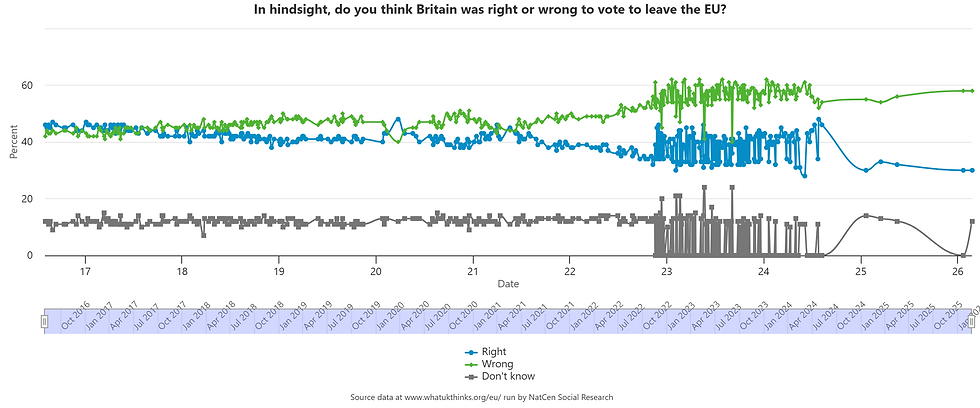
Source: National Centre for Social Research. 2026. "In hindsight, do you think Britain was right or wrong to vote to leave the EU?", What Britain Thinks, https://www.whatukthinks.org/eu/questions/in-highsight-do-you-think-britain-was-right-or-wrong-to-vote-to-leave-the-eu/?csv=1, accessed 9/6/2026.
There's also the current controversial suggestion that given many of the 'Leave' voters in 2016 were from older generations, a proportion of those who voted 'Leave' back then have literally passed away. Moreover, 22% of previously 'Leave' voters still alive today have since changed their minds and now want the UK to rejoin the EU. This analysis suggests that there is now a net 8 million majority of Britons in favour of the UK rejoining the EU.
We’re seeing the current political ructions going on in British politics opening up debates about this. Nigel Farage’s party, Reform UK, is of course pro-Brexit and has no truck with contemplating a return to the EU – Farage having been one of the major proponents of the Brexit vote in the first place.
The current Labour government, led by Sir Keir Starmer, has explored ways to rebuild relations with the EU in areas like defence, trade and scientific cooperation, but until recently was taking a step-by-step approach. Labour is cognisant that many of the so-called ‘Red Wall’ electorates in Northern and lower-income parts of England voted in support of Brexit. However, this hasn’t stopped Labour commentators opening up the old wounds of the Brexit debate. Potential contender in a future Labour leadership contest, Wes Streeting, has openly stated that if he’s appointed Prime Minister, he wants the UK to rejoin the EU. While other minor parties like the Liberal Democrats and the Greens have already called for this, this is the first time I’m aware that a possible future Prime Minister contender in a major party is actively canvassing a return to EU membership for the UK.
This shift is also being driven by geopolitics. As the global economy fractures into geopolitical blocs, the EU is reasserting its economic and political independence, in part a reaction to the actions of the Trump Administration in the United States. The suggestion is that the Trump Administration is, ironically, convincing more Brits that it might be a good idea for the UK to rejoin the EU.
Of course, there are other options available to the UK to become more integrated with Europe without fully rejoining the EU. There is active dialogue in the UK about adopting structures like those already in place for countries like Norway and Switzerland, neither of which are members of the EU but have trade agreements and other arrangements that provide some degree of economic integration with the EU. Going the 'Swiss route' might be an option for the UK to consider if it can't stomach full reintegration into the EU.
A long debate still to come …
I have often said that it took the UK two generations to enter the EU, and it will probably take at least another generation for it to leave.
It was always going to be a long process, but now with the UK’s low economic growth, external geopolitical tensions, and more British people coming to the view that Brexit was a mistake, the debate likely still has a long way to go.
Ten years on, with the country afflicted with a bad case of Bregret, the UK may yet have to make another decision at some point in the future.
There’s a lot more to come.


Comments