
Speaking Davosian: the clash of western worldviews at the WEF 2026 meeting
Updated: Feb 26
Brendan Shaw
"We are in the midst of a rupture, not a transition."
Mark Carney, Prime Minister of Canada, Speech, World Economic Forum, January 2026
I have to confess that there are times when I have thought the World Economic Forum (WEF) meetings in Davos were a bit of a circus.
Don't get me wrong. There have been some important moments and speeches at previous WEF meetings in the alpine Swiss town.
Xi Jinping's 2017 speech about the importance of the international cooperation and globalisation from a Chinese perspective, or the historian Rutger Bregman's 2019 admonition to the billionaires in the room to pay more tax for the greater good both come to mind.
But generally, my views on the WEF meeting in Davos have been mixed, to say the least.
Speaking and doing 'Davosian'
No, my memories of going to the WEF meeting are more in tune with the wry send-up of Davos featured in the Financial Times about 'speaking Davosian' - phrases people say that mean one thing but actually reflect another reality. There have been times when Davos has seen a lot of this.
The WEF does a lot of good work. But there have been some years where the annual WEF meeting in Davos has been worthwhile, and others where it seems to have been a waste of time. Sometimes, these meetings risk being places where people go to say lots of things, to be seen, but often nothing happens afterwards or seems to change.
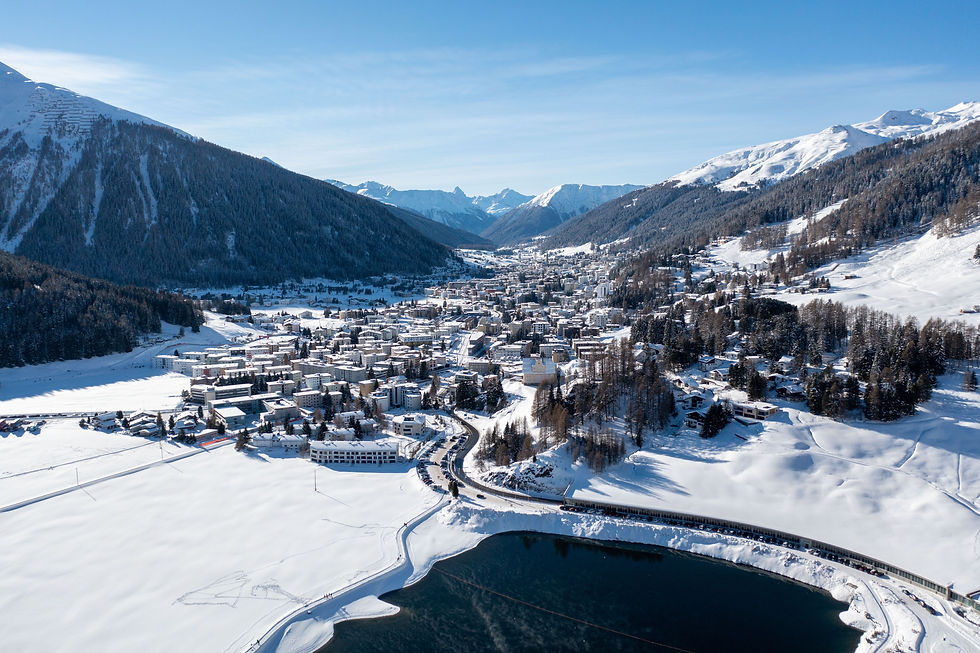
I might also be triggered by the actual logistics of getting around Davos during a WEF meeting. Maybe it's my Australian heritage, but I could never work out why so many people would choose to congregate in a small Alpine town for a global meeting in the middle of a freezing winter. With the slushy melting snow, blocked drains, long hours of darkness, and the cold. Why not hold the WEF meeting at a large city near a beach and nice, sunny weather with an airport nearby?
By all means, go to Davos to ski, to snowboard, and for the apres-ski. Use it for meetings, even, if there's a small group of you. But don't try to host large international meetings there. Don't try it with hundreds of CEOs, world leaders, academics, media and thousands of other followers all trying to cram into the town and overwhelming the place.
I distinctly remember destroying a perfectly good pair of business shoes and being late for a meeting after walking 2 km through snow 2 feet deep in a business suit because the bus I'd spent half an hour standing in the freezing cold waiting for was full. Or cars you've ordered to pick you up from somewhere never showing up, or the quaint but laboriously slow mountain train that winds its way to the Alpine valley where Davos sits.
Okay, maybe my experience at Davos probably says more about my level of preparation and status at WEF than anything else. I'm pretty sure Donald Trump or Xi Jinping would not have had the same experience.
So, no, my memories of WEF meetings at Davos were not always of signature moments in world history or breakthroughs in global understanding and consensus on world problems.
But this year, 2026, was different.
Clash of western worldviews on display
For all the jokes about speaking Davosian - saying one thing while meaning another - this year, 2026, was different.
It was different this year because there was plain speaking all over the place. It wasn't happy, it wasn't always pretty, but it put on display the fractures in western views on where the world is going.
It started with United States Secretary of Commerce, Howard Lutnick, being heckled and jeered by the audience at a dinner that 'descended into uproar' as he lambasted Europe and said the world should focus on coal as an energy source rather than renewables. It caused a walkout by several, including the president of the European Central Bank, Christine Lagarde.
But the real clash of views became apparent in consecutive speeches given by US President, Donald Trump, and Canadian Prime Minister, Mark Carney. Ironically, both are leaders of neighbouring North American countries that were former English colonies, but with vastly different views on where the world is going and what needs to change. So close, but yet so far.
Trump's speech was, in many ways, vintage Trump. He discussed global economics, his use of tariff policy, American exceptionalism, the 'fraud' of green energy, what he saw as the problems of 'mass migration' in western countries, and what he described as the decline of Europe and it being 'unrecognisable' due to excessive immigration. The reaction to Trump's speech, his announcements of a 'Board of Peace' to rival the United Nations, and subsequent presence at events in Davos brought mixed views.

By contrast, the speech by Canadian Prime Minister, Mark Carney, was a measured, but also firm discussion of where the world is going. Importantly, he also called out western complacency by critiquing the yearning in some parts of the world for a return to the rules-based international order. He called out what many knew, which is that this international rules-based order was partially built on falsehoods. He said that "We are in the midst of a rupture, not a transition." He called out countries that didn't push back against great power politics. Like Trump, pretty direct stuff.
Carney also urged middle power countries like Canada to work together to counter the rise of hard power and great power rivalry, so as to build a more cooperative, resilient world. He called on middle power countries to build new alliances and build strategic autonomy while maintaining values like human rights and sovereignty.
Arguably, the greatest significance of Carney's speech was to map out a way that middle power countries that aren't 'great powers' can build a new worldview. It's a guide for how middle powers can work with great powers without getting caught up in Thucydides' Melian Dialogue.
Carney suggests that middle powers build their own capability and sovereignty while also building new coalitions around 'values-based realism' - a phrase borrowed from Finnish Prime Minister, Alexander Stubb. It's well worth a read.
For his efforts, Carney was subsequently quickly un-invited to join the Board of Peace by Trump, and the US threatened Canada with 100% tariffs for resolving some trade issues with China.
The future
This year's WEF meeting may mark a moment in history where international affairs, foreign policy, economic development and business strategy all start to pivot.
Who would have thought the WEF could host such monumental international dialogues?
As for me, I love Switzerland. I also admire what the WEF provides, namely a neutral forum where politics, business, NGOs, academia, experts and others can spend a few days in a retreat and talk about big picture issues and where the world is going.
However, I think there are other warmer places where such dialogues could happen and where your shoes don't get destroyed by trying to get to meetings.
There are some marvellous places in the world where one can reflect on world events, are easy to get to, and are not freezing cold with slushy wet snow melt in the streets.
As I am writing this blog, I'm sitting near a nice beach in the Australian summer. If the WEF people want to get in touch, I'm happy to provide a few suggestions for where to host future meetings to contemplate the world's strategic issues.
You know where to find me.



Comments